When you’re persisting on something that matters, you’re bound to hit lows.
The question pops in your mind: do I stay the course? Am I being stubborn or persistent?
How do you even tell the difference?
This issue focuses on Character, one of the four directions of the Modern Compass. Character is how you show up when things get hard, and persistence is one of its clearest tests.
The Two Broken Models of Persistence
Most frameworks or guidance on persistence falls into two trains of thought:
1. Grit-and-Willpower Persistence
“Push harder, tough it out, embrace the suck. Winners never quit.”
This isn’t wrong, but it has gaps:
- Treats persistence like a character trait you either have or don’t
- Grit without adaptation is just stubbornness
- You can grind away for years on something that was never going to work and call it dedication
2. Passion-Driven Persistence
“Follow your passion and you’ll never work a day in your life. Stay connected to your why and you’ll never burn out.”
This sounds great until you hit month six and realize passion is not sustainable fuel.
Passion ebbs and flows. If your strategy is “stay passionate,” you’re done the moment enthusiasm fades.
Here’s the Thing
Both strategies have truth in them. You do need to endure difficulty and you do need to care.
They’re just incomplete in isolation.
They tell you how to feel a certain way, but don’t offer much when something stops working.
Real Persistence Is Structural
Persistence is extremely relevant to me being 11 months into book writing and all things Modern Compass, and encountering many failures this year and some successes.
Real persistence isn’t about superhuman willpower or never losing the spark.
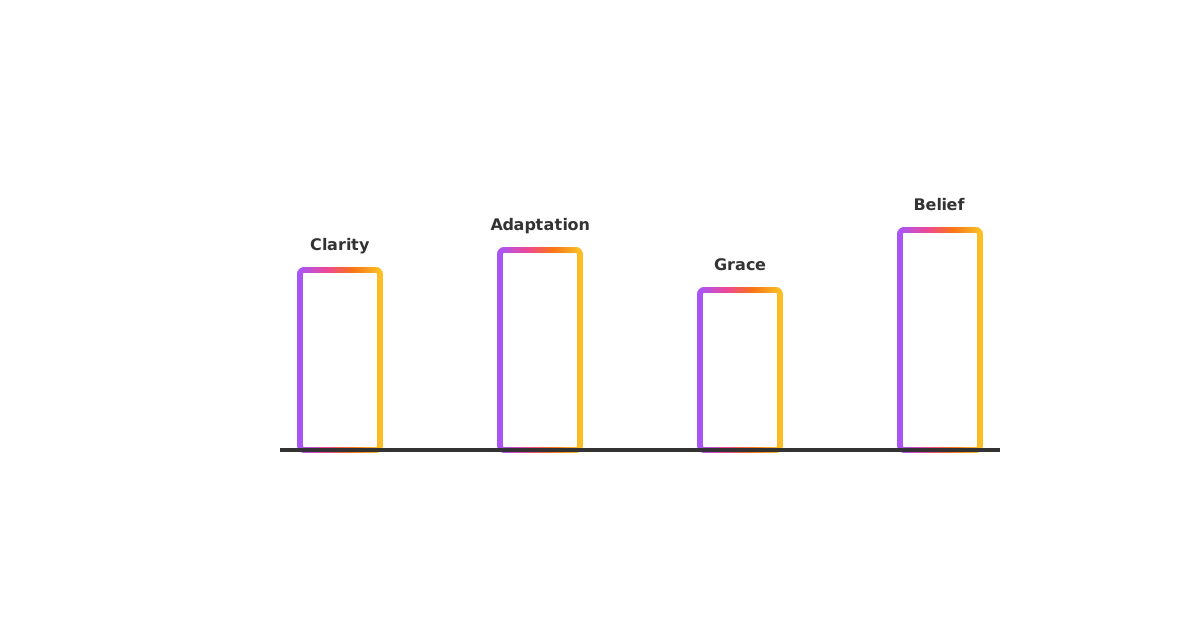
I see persistence as structural, built on 4 pillars, and when your persistence starts to show cracks, you can usually trace it back to a specific pillar.
The 4 Pillars of Persistence
Pillar 1: Clarity
You know exactly what you’re building and why it matters to you specifically.
Concrete enough that:
- Decisions become obvious
- You can filter out the noise
- The “what” and “why” are crystal clear
Pillar 2: Adaptation
Your willingness to change your approach while protecting the core intent.
Knowing the difference between:
- Pivoting tactics (smart)
- Abandoning the vision (giving up)
Pillar 3: Grace
You forgive yourself when you fall short without killing accountability.
Treating setbacks as part of the process rather than proof you’re failing.
It’s refusing both:
- Harsh self-judgment (“I’m a failure”)
- Empty excuses (“It’s not my fault”)
And instead asking: “What happened, what can I learn, and what will I adjust?”
Pillar 4: Belief
Trusting you’re capable of doing this work even when current evidence suggests otherwise.
Sustained through:
- Small wins
- Remembering why you started
- Having others believe in you
Important: Banking solely on external validation will lead to even more cracks. You must believe in yourself.
Pitfalls to Watch Out For
Leveraging AI for Pep Talks
Using ChatGPT for motivation hits that fade in twenty minutes.
Stop asking AI to tell you you’ve got this.
Start asking it to help you think through actual problems or identify gaps.
This is very difficult for ChatGPT to do - it’s often the worst AI at gaslighting you and thinking all your ideas are great. I recommend Claude if you want AI to give you more grounded criticism.
Chasing Social Proof/Comparison
Measuring yourself against people further ahead, mistaking where they are for where you should be.
Someone three years into their career isn’t your benchmark if you’re three months in.
A quote that rings true here: “Build something great before building it to be known.”
The catch is you need some external feedback to know if it’s actually great, but the principle holds. Focus on the quality of what you’re building, not comparison to others on a completely different timeline.
Assuming Success Stories Skipped the Struggle
You look at people who made it and think they had some advantage or may not realize how hard they worked to get there.
Read their early work or ask them directly (if possible) about the years before anyone cared.
3 Truths of Persistence
Truth #1: There Will Be Lows
Do anything long enough and you’ll hit them.
When they come, you’ll question whether it’s worth it. Not once, but repeatedly.
The question isn’t whether you’ll doubt - it’s what you will doubt, and often it will align to one of the pillars.
Truth #2: Progress Takes Time to Be Visible
You’re putting in effort and seeing nothing change. Then suddenly things click, compound, or someone notices.
Progress operates on a lag.
The work you do today might not pay off for months or years. You can’t see progress accumulating in real time, but that doesn’t mean it’s not happening.
I’ve created a tool called Creative Equity Review to document that invisible progress because it helps to recall what all you’ve done. Check out this article on creative equity if interested.
Truth #3: The Outcome You Want Is Never Guaranteed, But the Pursuit Is Always There for You
It doesn’t matter if you’re in highs or lows, how long you pause or take a break.
You can wake up the next day and the opportunity for pursuit is there. It never left.
Activity 1: Pushing Past the Lows
When you’re persisting on any endeavor, you’re bound to hit lows. Sometimes a low is your gut telling you something just isn’t working. Other times it’s just impatience or faulty comparison spiraling into doubt.
This exercise helps you figure out which one you’re dealing with.
Step 1: Isolate the Feeling
Name the exact thought causing the low.
Not “I feel bad about X” but “I feel like I’ve wasted X amount of time on (fill in the blank).”
Write it down on a piece of paper.
Step 2: Make It Someone Else’s Problem (Hypothetically)
Pretend you’re hearing this from a friend, not feeling it yourself.
Step outside it completely and look at that statement as a third party would. What would you notice about it that the person saying it can’t see?
Step 3: Separate Fact from Fiction
This one’s crucial!
Most lows aren’t caused by what’s actually happening. They’re caused by the story we tell ourselves.
Look at what you wrote. Think or write only what is objectively true. Strip out bias and assumption from reality.
Step 4: Reality Check Your Timeline and Effort
Evaluate your inputs (time & effort) to your output (results).
We all want more, but if you’re expecting far more results without the adequate input, there could be a mismatch.
Example: Career progression. You’re expecting a promotion but have you mastered the existing role you are in and done something to prepare yourself for the role you want?
If not, there is a mismatch. If there isn’t an opportunity to properly “prepare” yourself for future role, take courses, ask for more responsibility, be a board member in a volunteer group, etc.
Step 5: Determine a Pivot
Based only on the facts, what’s one thing you could change about your approach?
Not your entire strategy, just one tactical shift you could try next.
Few Examples of Where I’ve Pivoted with Modern Compass
Reduced content creation to 1-2 times weekly:
- Doing more wasn’t aligned well to outcome of writing a book
- Wasn’t growing a platform the way I expected
Stopped pursuing digital Etsy shop:
- Ended up being in direct conflict with writing
- Takes a long time to produce/market
- Instead repurposed these as free lead magnets for this newsletter
Quick side note: If you are looking to make a decision to stop pursuing, there are already some well established decision making frameworks out there and Clear Thinking book has become one of my favorites on decision making.
Activity 2: Leverage AI to Properly Critique You
Copy and paste this into ChatGPT (or better yet, Claude):
I’m working on [your goal]. Help me diagnose which pillar of persistence needs attention: Clarity (do I know exactly what I’m doing and why), Adaptation (am I willing to change my approach), Grace (can I recover from setbacks), or Belief (do I trust I’m capable). Ask me questions one at a time—2 questions per pillar. After I answer all questions across all four pillars, provide an honest assessment of which pillar might be giving me my biggest issues and thoughts on how to course correct. The assessment should be constructive but direct. The goal is truth, not encouragement.
My Results from Testing the Prompt
For one I test any and all prompts I co-develop with AI that go in my newsletter.
This prompt was very insightful and called me out on clarity being an area I may have some cracks, mostly around ensuring there is market fit for my book.
Again I suggest Claude as one of the better AI models to give grounded feedback to you.
If you’re from the camp of grit & willpower and wondering if you are actually adaptive or lean more on the stubborn side, do this prompt! You will get something useful from it, I certainly did!
The Bottom Line
Persistence isn’t a character trait. It’s a structure.
When persistence starts cracking, trace it back to the pillar:
- Clarity - Do you know what you’re building and why?
- Adaptation - Are you willing to pivot tactics?
- Grace - Can you recover from setbacks without harsh judgment?
- Belief - Do you trust you’re capable?
Fix the pillar. Strengthen the structure.
Always… follow your compass.
- Josh
More Resources
- Want to track invisible progress? → Read Creative Equity: Why Creating for Yourself Compounds
- Need accountability to stay consistent? → Read Why Accountability Comes Before Habits
- Ready to build your compass? → Explore the Modern Compass book